
Refrigeration and Air Conditioning
Installing and servicing climate systems.
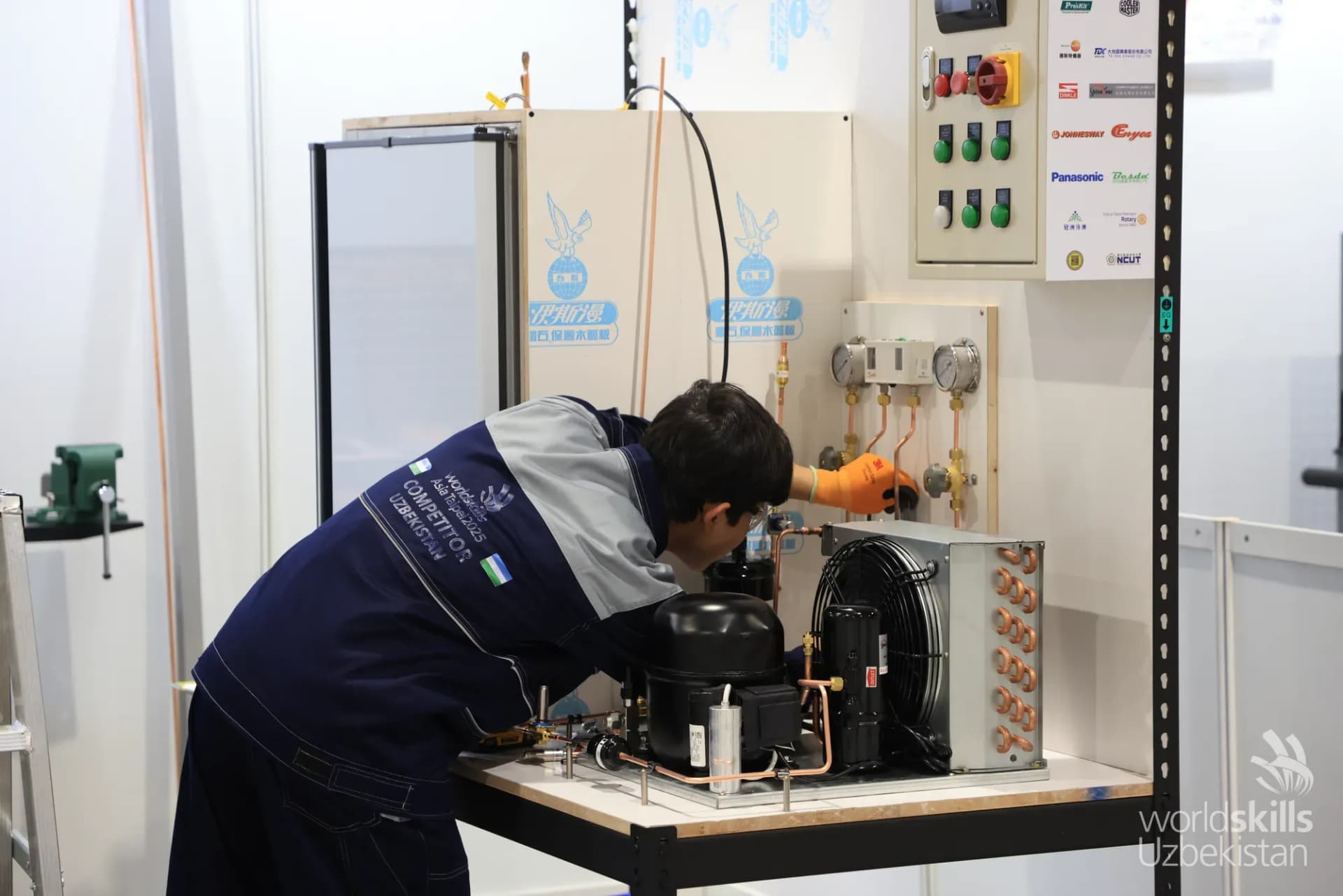
A refrigeration and air conditioning technician builds, charges and commissions systems that move heat from one place to another — from a shop display cabinet to industrial plant.
Competitors braze the copper circuit, evacuate the system, charge it with refrigerant, measure pressures and temperatures and bring the compressor to the required duty. A separate module is fault finding: judges introduce a fault in advance and the competitor must locate it with instruments and reasoning.
Handling refrigerants is tied directly to environmental rules — venting gas incorrectly also affects the marks.
Requirements
Understanding the refrigeration cycle (evaporation, compression, condensation, expansion) and reading a p–h diagram.
Brazing copper, brazing under nitrogen, evacuation and correct charging procedure.
Reading electrical schematics, setting up thermostats and controllers, and a systematic approach to fault finding.
Equipment
Vacuum pump, manifold gauge set, scales and charging cylinder, electronic leak detector.
Brazing kit: torch, nitrogen cylinder and regulator, tube bender and flaring tool.
Measurement: contact and infrared thermometers, clamp meter, anemometer.
Assessment criteria
System performance: refrigerant charge, superheat and subcooling must fall within the specified range — all verified by measurement.
Leak tightness and vacuum level are marked separately; if a leak is found the module is not re-assessed.
In the fault-finding module the number of faults located, the time taken and the logic of the diagnosis all count.