
Plumbing and Heating
Installing water and heating systems.
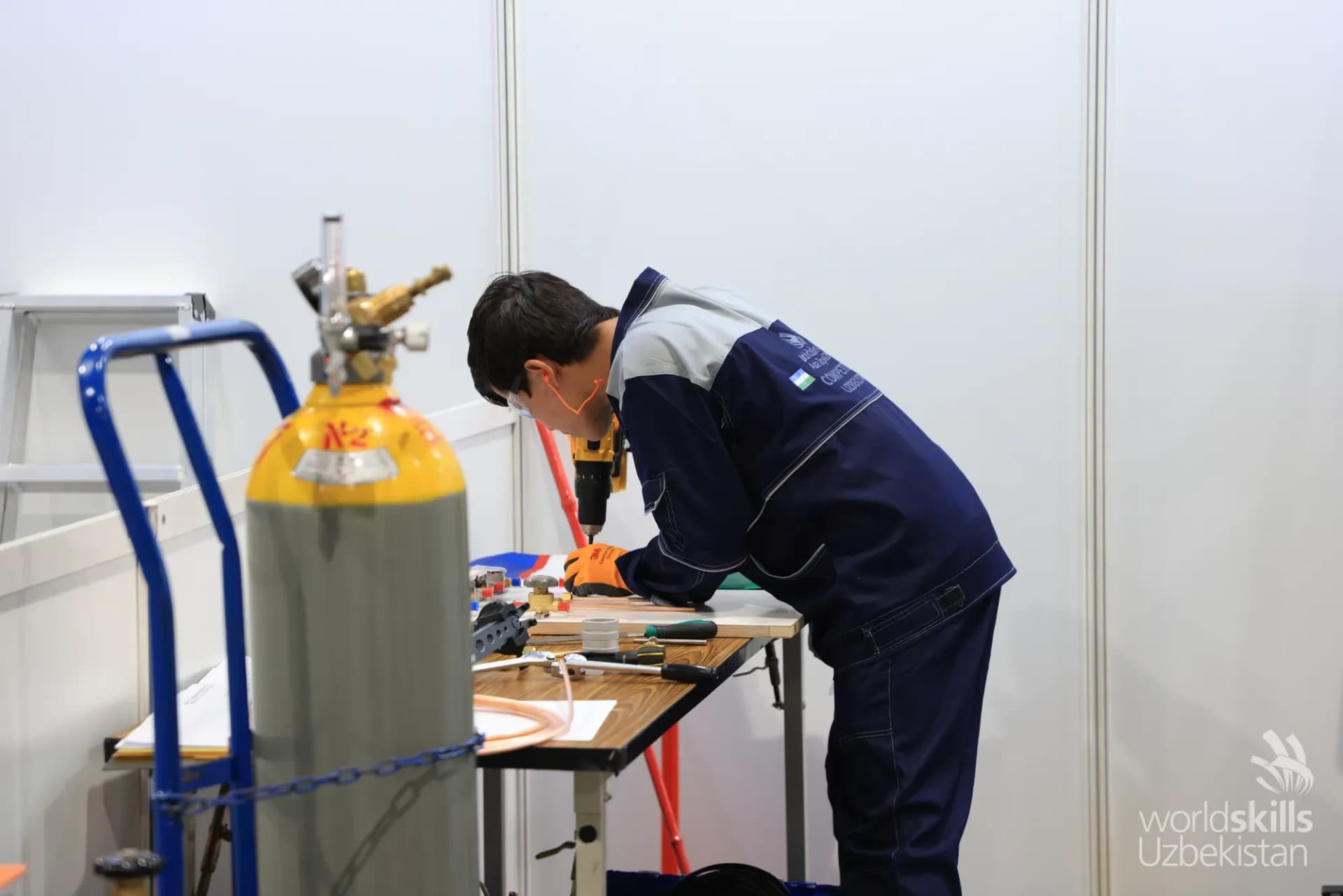
A plumbing and heating technician brings water, heat and drainage into a building. The work usually ends up hidden inside walls — but one badly made joint can flood an entire floor.
Competitors work with copper, steel and plastic pipe: copper is brazed, steel is threaded or press-fitted, plastic is fusion welded. Radiators, manifolds, a circulating pump and controls are connected, and the system is pressure tested. Some modules include energy-efficient equipment such as a solar collector or heat pump.
Fourteen competitors took part in this skill at the Samarkand stage in 2025.
Requirements
Reading isometric and plan drawings, sizing pipe diameter and fall, understanding system hydraulics.
Soft and hard soldering of copper, threading steel, PPR fusion welding and press-fit jointing.
Safety rules for hot works and for pressure testing.
Equipment
Pipe cutter, threading dies, press tool with jaw set, PPR fusion welder, gas torch.
Measurement: spirit level, angle gauge, tape measure, pressure gauge and test pump.
Materials: copper, steel and PPR pipe, fittings, radiators, manifold and circulating pump.
Assessment criteria
Leak tightness is the first and decisive criterion: the system must hold the specified pressure for the specified time. A leak means a heavy loss of marks for the module.
Measurement: pipe centre lines against the drawing, fall, mounting heights, bracket spacing.
Judgement: cleanliness of brazed and welded joints, neatness of the pipe runs, material usage and housekeeping.