
Plastering and Drywall Systems
Interior finishing and drywall systems.
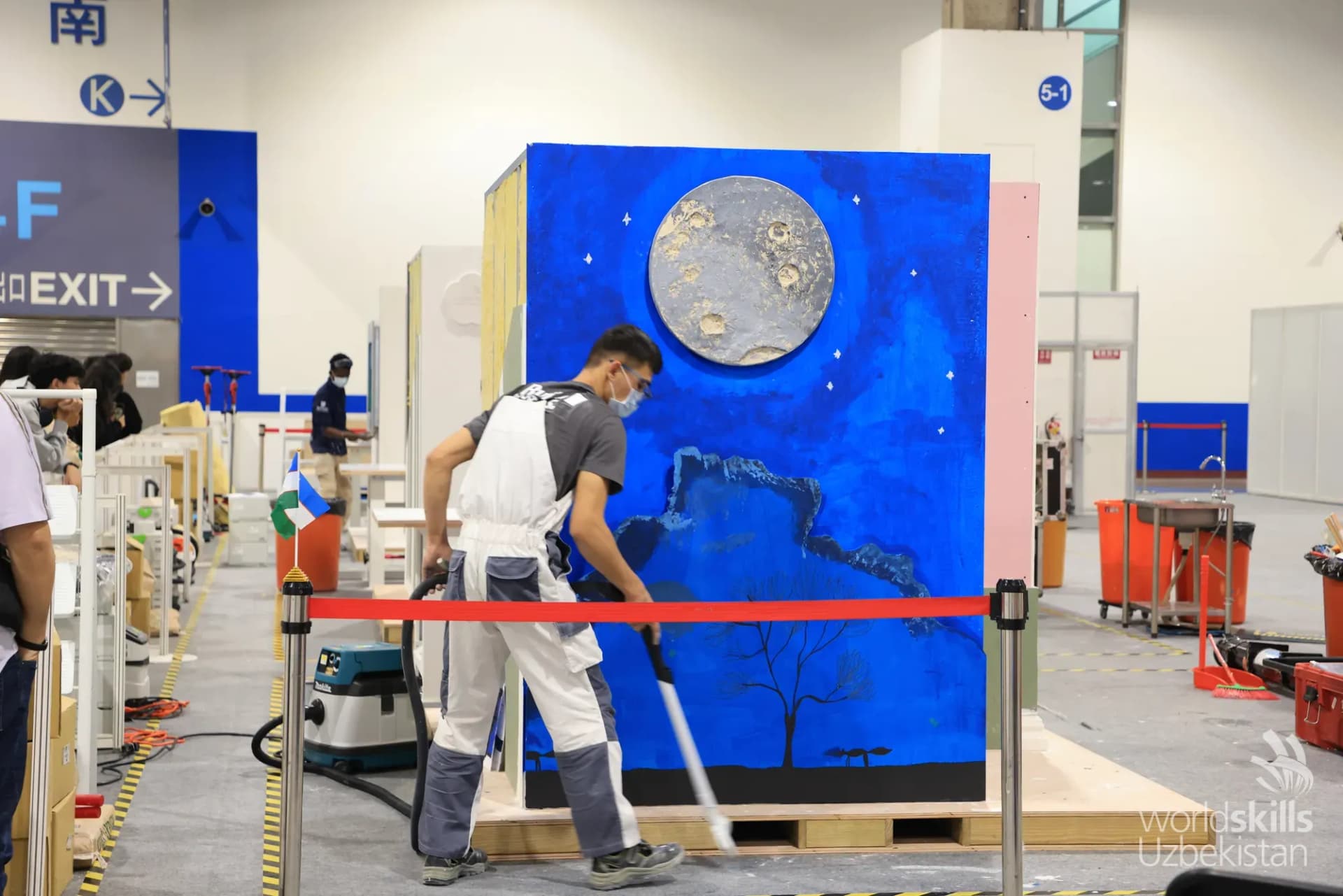
Plastering and drywall systems means building partition walls from steel studs and plasterboard, multi-level ceilings, arches and curved surfaces — and finishing them perfectly flat. Most internal partitions in modern buildings are built this way.
A competition task usually involves geometry that is far from simple: precise angles, even radii, a surface that is uniform even to the touch. Joints are then filled, skim-coated and sanded to level Q4 — a finish with no visible trace under raking light.
Uzbekistan took 3rd place and a Best of Nation medal in this skill in Abu Dhabi in 2023.
Requirements
Transferring dimensions from drawing to site, setting out the frame with a laser, selecting profile type and stud spacing for the load.
Bending plasterboard, multi-layer boarding, correct movement joints; applying filler in layers with the right drying times.
Strict compliance with dust and working-at-height safety rules.
Equipment
Profile punch and snips, cordless screwdriver, laser level and chalk line, long straightedge (2–3 m).
For finishing: taping knives of several widths, smoothing trowel, sanding mesh with dust extraction, a hand lamp for raking-light checks.
Materials: studs and tracks, standard, moisture- and fire-resistant board, jointing tape, primer.
Assessment criteria
Measurement carries the largest share: overall dimensions, deviation from plumb and level, accuracy of angles and evenness of radii — all checked in millimetres.
Surface quality is judged separately under raking light: no joint lines, hollows or sanding marks should remain.
Judgement marks cover the sequence of work, material economy and housekeeping.
Experts
Azimov Azizbek Adizovich
Mentor Expert
Yashiev Firdavsiy Farkhodovich
Chief Expert